What is a frameless glass partition?
A frameless system uses minimal hardware — typically a slim floor and ceiling channel with structural silicone joints between panes. The result is an almost continuous glazed plane with no visible vertical framing. It is the system specified when the intention is that the partition should disappear.
What is a framed glass partition?
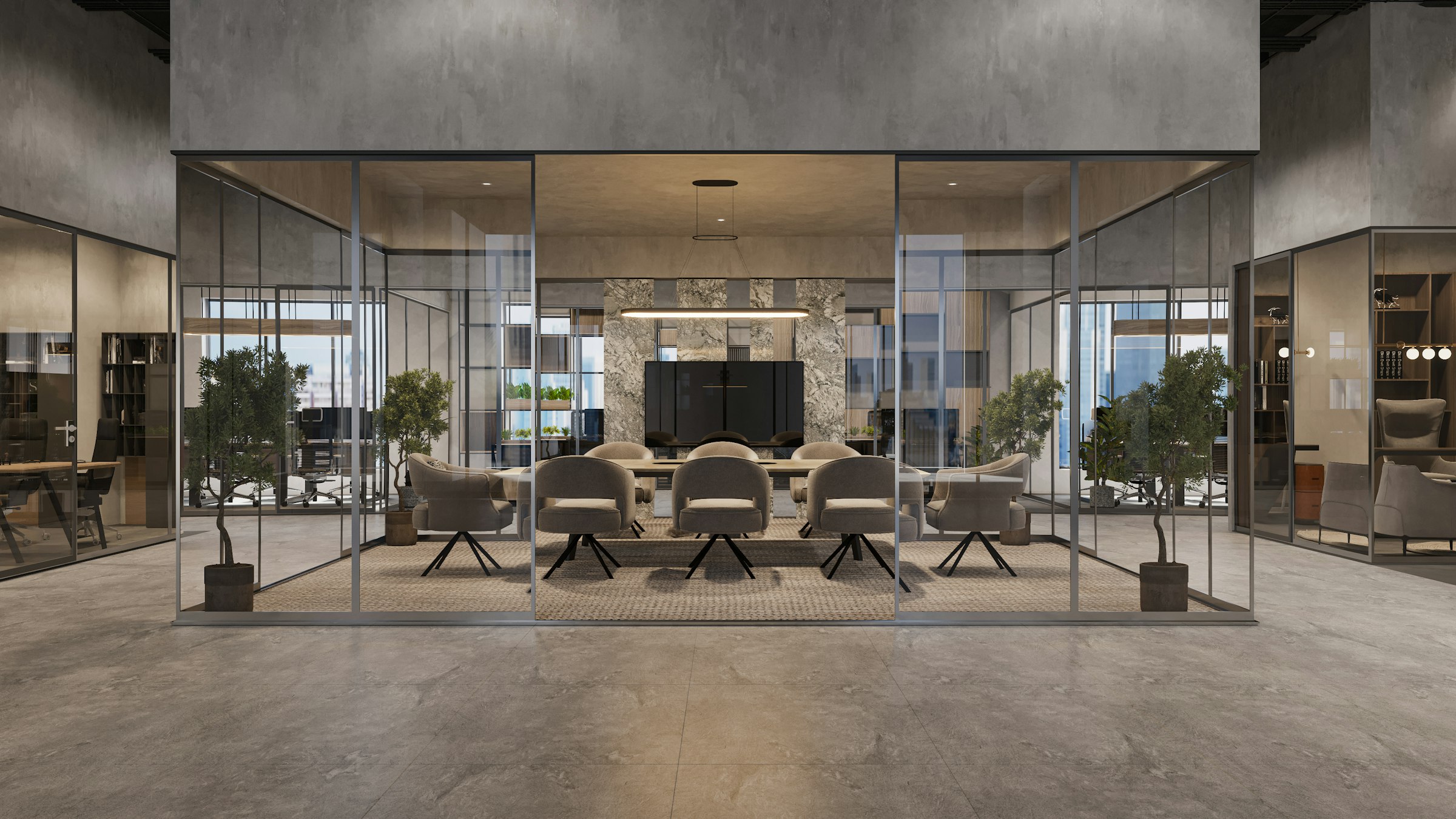
A framed system carries the glass in a visible metal framework, usually aluminium. The framework provides structural support, simplifies alignment and gives a defined place for seals, services and door frames. It reads as an assembled element rather than a continuous surface.
Key differences
- Appearance. Frameless reads as sleek and minimal; framed reads as defined and modular.
- Installation. Frameless demands tighter tolerances and more skilled installation. Framed systems are more forgiving of building tolerance.
- Light transmission. Frameless carries marginally more daylight, simply because there is less obstruction.
- Acoustics. A framed system with proper seals generally offers better and more repeatable acoustic separation.
- Maintenance and reconfiguration. Framed systems are easier to demount and reconfigure. Frameless work is closer to permanent.
- Cost. Frameless typically carries a higher installed cost, largely in labour and tolerance.
Which option looks better?
Frameless wins on minimalism, and that matters most in client-facing space, executive floors and brand-led environments. But a well-detailed framed system in a considered finish does not read as a compromise — it reads as a different design language.
Which option provides better value?
Value depends on how long the layout will last. If the floor plate is going to be reconfigured within a few years, a demountable framed system usually returns more. If the partition is defining a permanent, high-visibility space, frameless earns its premium.
Compared with other partition solutions
Both glass systems can carry switchable privacy — either as laminated switchable glass in the panel, or as retrofit film applied afterwards. That changes the comparison, because a glazed partition that can become opaque on demand competes directly with solid partitions rather than only with other glass.
How to choose
Work through it in this order: how long the layout has to last, what acoustic separation the rooms actually need, whether privacy has to be on demand, what the space is meant to communicate, and only then the budget. Choosing on budget first tends to produce a partition that has to be replaced.